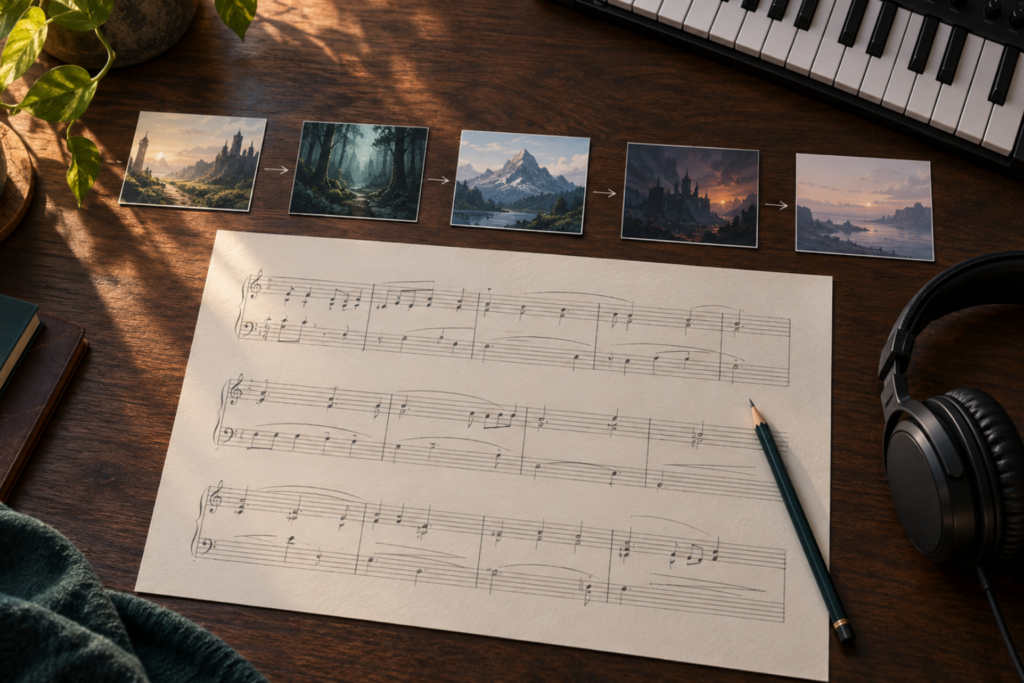
To write a score for a game, start with a map of the game rather than a finished theme. List the player actions and scenes that may need music, give each cue a job, agree on a small shared sound palette, then sketch the cues needed for the first playable build. Test those sketches in the game with the developer and revise the cue list as the design changes. The worksheet below turns that process into decisions you can track.
Read the game before writing the music
Ask for a playable build if one exists, a level map, and a conversation with the designer. Where does the player spend time? What can happen in a different order? Which moments carry dialogue, prominent effects, or information the player must hear? A composer working only from a trailer or a written mood word misses the duration and repetition that actual play creates. Michael Sweet’s Berklee Online lesson on interactive scoring explains why game music follows player-driven events rather than a fixed sequence.
Turn the conversation into specific questions. Is exploration meant to feel safe, uncertain, or lonely? Does an encounter begin suddenly or build from a warning? Will the player return to a menu after every attempt? Does dialogue continue during exploration? Which part of the game must be playable at the next review? The answer to each question can change the cue list. “Mysterious” is a direction for discussion; “leave the clue reveal quiet so the spoken line is clear” is a decision the team can test.
Mark scenes that may need no music. Silence can give effects and dialogue room and make the next musical entrance more noticeable. Treat it as a planned state, with a reason and an approval owner, rather than an empty row you forgot to score. The aim is to map the player’s experience, including the gaps between musical events.
Build a cue list for the whole game
A cue list is a working agreement between composer and developer. Give each row a player trigger, an emotional or practical job, a proposed musical relationship, a playback type, a priority, and a person who can approve the sketch. Keep the row short enough to scan during a meeting. Add a link to a rough audio file and a status column when real work begins.
The following is an illustrative five-scene plan for an imaginary exploration game. It is a planning example, not a claim about a released game or a required industry template.
| Scene or player action | Music’s job | Cue or motif plan | Playback | Priority for first build | Sketch approval |
|---|---|---|---|---|---|
| Open the menu | Introduce the world without tiring the player before play | A spare version of the home motif | Repeatable bed | Later, if the build opens directly in play | Creative director |
| Explore the valley | Support curiosity while leaving space for environmental sounds | Home motif in a light texture | Loop or sparse musical blocks | Essential | Level designer |
| Enemy notices the player | Signal a change in risk | Rhythmic variation of the valley material | Layer or transition | Essential if combat is in the build | Combat designer |
| Find the hidden map | Let the discovery register without covering a spoken clue | Brief motif fragment, or silence after a sound effect | One-shot or silence | Test with dialogue first | Narrative designer |
| Reach the ending | Give the journey a sense of arrival | Fuller statement of the home motif | One-time cue | Later | Creative director |
The “essential” rows are tied to the first build, not to a universal hierarchy. If the next build contains only a menu and a conversation, those priorities would change. The approval column prevents a common ambiguity: a composer can finish a sketch that one teammate likes while the person responsible for the scene has never heard it. Record who makes the call and what version they approved.
Use the sheet to find gaps before writing more music. A long exploration scene with several entrances may need one shared bed and a transition, rather than three unrelated tracks. A story scene may need silence. A cue whose emotional job duplicates another can often reuse material, but decide that with the build open, not from filenames alone.
Choose a musical identity that can travel between scenes
Pick a compact palette: perhaps a small group of instruments, a texture, and a short melodic shape. Write down what each choice communicates. A dry plucked sound might leave room for footsteps; a held tone might connect distant locations. These are design hypotheses for the imaginary game, not rules about which instrument belongs to a genre. Audition them against the visuals and effects before turning them into the sound of the whole score.
A motif gives separate cues a family resemblance. It need not appear at full volume in every scene. In the worksheet above, the home motif could be reduced to two notes in exploration, made rhythmically urgent when danger appears, and stated more fully at the ending. For a closer look at developing a recognizable musical idea, see our guide to writing character themes. Here the important decision is where the motif earns a place in the game-wide plan.
Real projects can also need contrast. In No Film School’s interview with composer Robert Arzola, he describes trying jazz and reggae approaches for parts of Tactical Breach Wizards and discussing an unusual house scene with Tom Francis. That example supports a practical point: the shared identity should be flexible enough for a scene with a different dramatic job. It does not mean every cue must use the same genre or instrumentation.
Sketch the smallest useful set
Work backward from the next playable milestone. Which cue will let the team judge whether the game has the right musical direction? Which second cue will test contrast or a change of state? Make rough versions of those first. A short, clearly named sketch is easier to discuss than a polished full-length track whose basic premise is still undecided. Keep a dated version and put its link in the cue sheet.
For the imaginary exploration game, start with the valley bed and the danger variation if that is what players can test. A menu arrangement and ending can wait until those scenes exist. The discovery row might start as a deliberate silent space under the line of dialogue. If the silence fails, the team can test a brief motif fragment. This order is a proposal for that example, not a claim that all games should be scored in the same sequence.
Sketches should expose the decision you want feedback on. Render the music at a level that can be heard alongside game audio, and state what is provisional: melody, texture, placement, or transition. Do not ask “do you like it?” alone. Ask whether the cue changes the player’s reading of the scene in the intended direction. Save production and delivery polish for a direction the team has heard in context.
Decide how the cues connect
Player-controlled duration makes a fixed beginning, middle, and end difficult for some scenes. A repeatable loop can hold an exploration state; a short stinger can mark a discovery; a transition can bridge two states. The Midnight Music guide to composing for games sets out intro, loop, transition, stinger, and ending roles as connectable musical blocks. You can mark these roles in the cue sheet before choosing how to implement them.
Also mark where gameplay should alter existing material. A danger layer might join the exploration cue when the enemy approaches, while a different event might call for a new cue. Berklee’s lesson describes adding or removing layers and switching between cues as distinct interactive techniques. Your plan only needs to specify the trigger and the intended musical result at this stage. Our adaptive music guide works through a single cue and its implementation; use it when the team is ready to build that behavior.
Listen to the joins, not just the individual files. Does the first note of the loop feel like an accidental restart? Does an encounter end while the danger layer keeps playing? Does the discovery stinger collide with dialogue? Record each failure against the relevant row. For details on event timing, see our music-to-gameplay synchronization guide. If the implementation needs separate musical parts, the stem delivery guide covers packaging and handoff.
Review the score with the developer
Play the build together with the cue sheet open. For each row, check the trigger, the intended feeling, the duration, and what else is audible. Run through a quiet stretch and a busy stretch. Repeat a scene more than once: a cue that works on its first entrance may crowd the player after several attempts. Ask the developer to identify any missing moment or scene whose purpose changed since the last review.
Write feedback as an actionable note attached to a version: “Valley sketch 02 masks the clue line at the bridge; try a thinner texture there” is more useful than “make it less busy.” Record the reviewer, decision, and next action: approved, revise, or remove. If two stakeholders disagree, capture the disagreement and ask who owns the scene. A clear decision protects both the music and the schedule.
Finally, update the cue list after each playtest. Music may move, split, merge, or disappear as the level changes. That is normal for a working score. The sheet is useful because it shows the game as a connected experience, not as a folder of finished audio files. It tells the team which cue exists, what it is meant to do, and what still needs an answer.
FAQ: Planning Your First Game Score
How many cues does a small game need?
There is no fixed number. List the moments in the playable build, decide where music has a clear job, and leave space for silence. Start with the cues that let the team test the game.
Should I write the main theme first?
Write a short motif sketch early if it helps connect the cue list, but test it against an actual scene before arranging a full theme. A useful sketch answers a gameplay need.
What should go in a game music cue sheet?
Record the scene or player action, the music’s purpose, cue or motif, playback type, priority, sketch link, reviewer, and approval status. Add a note for any transition that needs testing.
Do all game cues need to loop?
No. Exploratory states may need repeatable music because their length varies. A discovery hit, ending, or deliberate silence may work better as a one-time event or no music at all.
When should the developer review the music?
Review a rough sketch in a playable build before polishing it. Ask whether it supports the player action, leaves room for dialogue and effects, and still works after repeated play.

Keep reading


Practical guides for game composers. Each guide links the documentation, published surveys and maker pages it relies on, so you can check the claims yourself. About us · Report an error