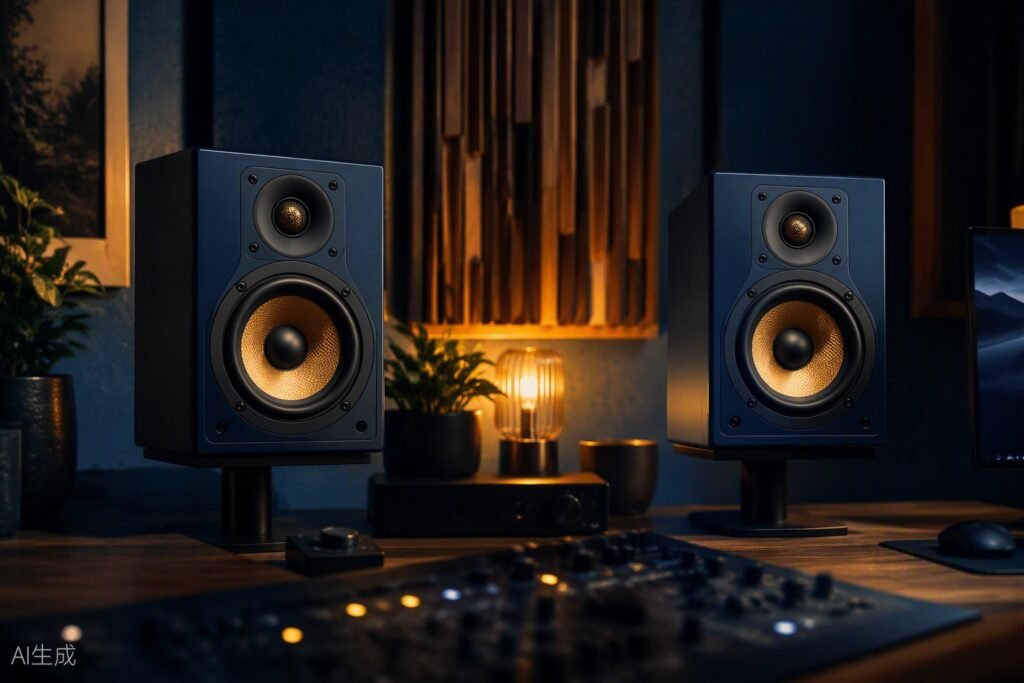
The best studio monitors for composers in home studios balance accurate frequency response, clarity, and size suited to your space. Popular 2024 models include Yamaha HS5, JBL 305P MkII, Kali Audio LP-6 V2, and Focal Alpha 80 Evo. Five-inch monitors are ideal for most small rooms; room treatment is often more critical than buying pricier speakers.
Why Studio Monitors Matter for Game Composers
For game composers, studio monitors are more than just speakers—they are precision tools for critical listening. Unlike consumer speakers, the best studio monitors for composers offer a neutral, accurate sound that helps expose flaws in your mixes. With complex, layered arrangements typical of video game music, clarity in the midrange and detailed stereo imaging become essential. Monitors that reveal these details empower you to make informed decisions about frequency balance, spatial placement, and dynamic range, all of which directly impact how your soundtrack translates to different playback systems.
Top Studio Monitor Models for Home Studios (2024)
Several models stand out in composer and professional circles for their accuracy, value, and reliability. Here’s a comparison of the most recommended options for 2024:
| Model | Size | Price (Pair) | Strengths | Ideal For |
|---|---|---|---|---|
| Yamaha HS5 | 5-inch | $450 | Industry standard, clarity | Reference, accuracy |
| JBL 305P MkII | 5-inch | $300 | Value, good imaging | Small home studios |
| Kali Audio LP-6 V2 | 6-inch | $300 | Wide sweet spot, detail | Layered/game music |
| Focal Alpha 80 Evo | 8-inch | $900 | High-end detail, power | Larger/treated rooms |
| PreSonus Eris Pro 8 | 8-inch | $500 | Balanced, versatile | Composing/mixing |
| IK Multimedia iLoud MM | 3-inch | $300 | Ultra compact, portable | Travel/desktop setups |
Each monitor brings unique strengths. The Yamaha HS5 is an industry benchmark for reference mixing, prized for its unforgiving clarity—if your mix sounds good on these, it’ll sound good anywhere. The JBL 305P MkII and Kali Audio LP-6 V2 offer excellent performance for tighter budgets, with strong imaging and a wide sweet spot. For those working in a larger, well-treated room, the Focal Alpha 80 Evo delivers power and detail that suit demanding orchestral or cinematic music.
5-Inch vs 8-Inch Monitors: What’s Best for Your Room?
The question of monitor size is critical. Five-inch monitors, such as the Yamaha HS5 or JBL 305P MkII, hit a sweet spot for most home studios—providing enough bass extension and detail without overwhelming small, untreated rooms. They are often the preferred choice for composers working in bedrooms or shared spaces. Eight-inch models, like the Focal Alpha 80 Evo or PreSonus Eris Pro 8, offer more low-end power but can create bass buildup or muddiness unless your room is large and acoustically treated. If you’re producing orchestral mockups or cinematic scores and have invested in room treatment, 8-inch monitors become more justifiable.
- Small rooms (<150 sq ft): 5-inch monitors recommended
- Medium/large rooms (>150 sq ft, treated): 6 to 8-inch monitors possible
Room Treatment vs Speaker Quality: What Impacts Your Mix More?
Room acoustics have a massive influence on what you hear—often more than the price or quality of your monitors. Foam panels, bass traps, and strategic placement can tame reflections, standing waves, and bass issues. In fact, many experienced composers on forums report improved mix translation after basic room treatment, even with modest monitors. If your budget is limited, prioritize affordable room treatment before upgrading from, say, a JBL 305P MkII to a pricier Focal or Genelec.
For more detail on optimizing your setup, see our guide to home studio essentials.
Monitor Placement and Setup Tips
Proper monitor placement maximizes accuracy. Here are practical steps:
- Position monitors so tweeters are at ear level and form an equilateral triangle with your listening position.
- Avoid placing monitors directly against walls—leave a gap of 6–12 inches to reduce bass buildup.
- Angle monitors slightly inward (toed-in) toward your head for a focused stereo image.
- Use isolation pads or stands to decouple speakers from your desk, minimizing unwanted resonance.
Refer to the audio interface guide for advice on monitor connectivity.
Accessories: Stands, Subwoofers, and Isolation Pads
Accessories enhance your monitoring accuracy:
- Stands: Raise monitors to ear height and allow for precise positioning.
- Isolation pads: Reduce vibrations and desk reflections.
- Subwoofers: Rarely needed for composing unless you’re mixing genres with deep bass or want to check low-end translation. For most, 5- or 6-inch monitors suffice.
How to Match Monitors to Your Workflow and Music Style
Different genres and workflows may require different monitoring priorities. For dense, layered game music, choose monitors with clear midrange and accurate imaging (Yamaha HS5, Kali LP-6 V2). If you work mainly with electronic or cinematic music and your room supports it, consider a larger model or a subwoofer for more bass detail. Compact options like the IK Multimedia iLoud MM suit composers needing a portable or desktop solution.
Always test your mixes on multiple playback systems—headphones, consumer speakers, and even laptops—to ensure consistency.
FAQ: Studio Monitors for Composers
- What size studio monitors should I use in a small home studio?
5-inch monitors are recommended for most small home studios, balancing detail and manageable bass without overwhelming the space. - Do I need a subwoofer for composing game music?
Most composers do not need a subwoofer unless they mix bass-heavy genres or work in a treated room. 5- or 6-inch monitors usually suffice. - Are 5-inch or 8-inch monitors better for orchestral music mockups?
8-inch monitors provide more low-end detail ideal for orchestral mockups, but only suit larger, treated rooms. Otherwise, 5-inch monitors are more practical. - Will room treatment improve my mixes more than new monitors?
Yes, effective room treatment often delivers a greater improvement in mix accuracy than upgrading to more expensive monitors. - Which studio monitor brands are most trusted by composers?
Yamaha, JBL, Kali Audio, Focal, Genelec, and PreSonus are widely trusted in composer and professional audio communities.
🎛️ Gear mentioned in this guide
- MIDI keyboard: Akai MPK Mini MK3 — best budget pick for composers
- Headphones: Audio-Technica ATH-M50x — honest mixing reference
- Interface: Focusrite Scarlett 2i2 — clean recording, zero fuss
As an Amazon Associate we earn from qualifying purchases. Full list on our Recommended Gear page.