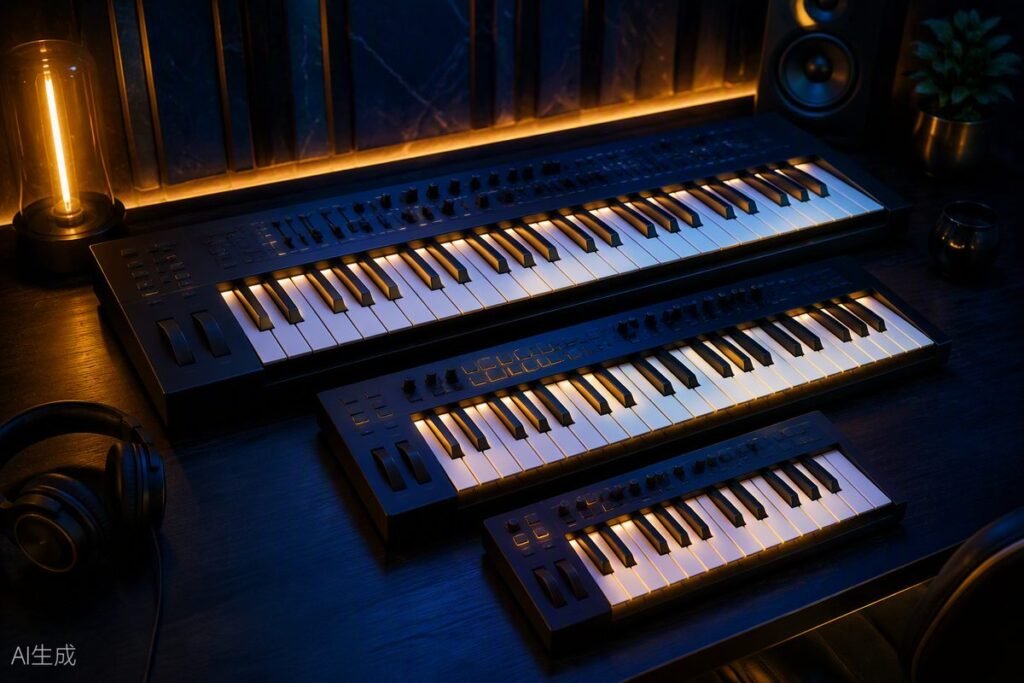
A MIDI keyboard is the most important physical tool a composer owns. You can write orchestral music clicking notes with a mouse — the same way you can dig a garden with a spoon. Playing your parts in, even imperfectly, is faster, more musical, and better for your creativity. This guide picks the best MIDI keyboards for composers at every budget, with the specific features that matter for game music work.
What Matters for Composers (Not Beatmakers)
- Key count: 49 keys is the practical minimum for two-handed orchestral parts; 61 is the sweet spot; 88 weighted keys if piano is your main instrument.
- Key action: semi-weighted keys suit most composing; fully weighted hammer action suits pianists writing at the keyboard.
- Mod wheel & pitch bend: non-negotiable — orchestral expression lives on the mod wheel (CC1). Avoid synths-style touch strips for this work.
- Pads and knobs: nice for beatmaking, secondary for scoring. Don’t pay extra for features your workflow won’t use.
- DAW integration: transport controls (play/record/stop) save real time in long sessions.
The Quick Picks
| Budget | Our pick | Why |
|---|---|---|
| Under $120 | 49-key USB controller class (e.g., entry-level 49-key controllers) | Everything a beginner needs, nothing they don’t |
| $150–$250 | 61-key controller with wheels + transport controls | The composer’s sweet spot |
| $300–$500 | 61-key premium controller with deep DAW integration | Better keybeds, aftertouch, workflow screens |
| $500+ | 88-key hammer-action controller | For pianists and film-style writing |
Best Under $120: The 49-Key Starter Class
The entry-level 49-key controllers from the major brands (Akai, Novation, M-Audio, Alesis) are all competent: USB-powered, velocity-sensitive keys, pitch and mod wheels, and a handful of knobs. What to check before buying:
- Real mod wheel, not a touch strip — you’ll ride it constantly for string dynamics.
- A sustain pedal input — essential for piano and pad parts.
- Bundled software: many include a free DAW or instrument bundle that adds real value at this price.
Any of the big-name 49-key options will serve you well for your first year of composing. Spend the savings on a starter orchestral library instead.
Best $150–$250: The 61-Key Sweet Spot
This is where most working game composers land. 61 keys give you room for two-handed orchestral writing — left hand voicings, right hand melody — without dominating your desk. Look for:
- Semi-weighted keys with a decent feel — you’ll notice the upgrade from entry-level immediately.
- Transport controls mapped to your DAW.
- Assignable faders/knobs: map one fader to CC1 (modulation) and one to CC11 (expression) and your orchestral mockups instantly sound more human.
Controllers in this class from Novation, Arturia, and Native Instruments all integrate deeply with major DAWs; pick whichever matches your DAW from our DAW comparison.
Best $300–$500: Deep Integration Controllers
Premium controllers add aftertouch, better keybeds, color screens, and deep integration with plugin ecosystems (browsing and tweaking instruments from the keyboard itself). Worth it when composing is paying you — the time saved browsing sounds adds up across projects. Not worth it as a first purchase.
Best for Pianists: 88 Weighted Keys
If piano is your native instrument, a hammer-action 88-key controller (or a digital piano with MIDI out) changes how you write — full-range two-handed parts, real pedaling, and phrasing you can’t fake with smaller boards. The trade-offs: desk space, weight, and price. For hybrid composers, many keep an 88-key board as the main instrument and a compact 25-key unit for travel.
Setup Tips That Instantly Improve Your Mockups
- Map a fader or knob to CC1 (modulation) and ride it while recording string and brass parts — this single habit separates amateur mockups from convincing ones.
- Add CC11 (expression) on a second fader for swells and fades.
- Record in passes: notes first, then a second pass riding the wheels and faders. Two mediocre passes beat one perfect take.
- Set a comfortable velocity curve in your DAW — most controllers let you adjust how hard you must strike for full volume.
Where to Buy (and Support This Site)
MIDI controllers are stocked by all major music retailers — Amazon, Sweetwater, Thomann, and Guitar Center all carry the full range, often with bundles that include software. If you purchase through links on this site we may earn a commission at no cost to you — see our affiliate disclosure. Whichever model you choose, the best MIDI keyboard is the one that stays on your desk and gets played daily.
🎛️ Gear mentioned in this guide
- MIDI keyboard: Akai MPK Mini MK3 — best budget pick for composers
- Headphones: Audio-Technica ATH-M50x — honest mixing reference
- Interface: Focusrite Scarlett 2i2 — clean recording, zero fuss
As an Amazon Associate we earn from qualifying purchases. Full list on our Recommended Gear page.